
The Nigerian filer's IFRS reference library.
Every active IAS and IFRS standard. IFRS Sustainability Standards. Implementation guides, industry applications, the latest IASB and FRC updates, FAQs and a full download centre — all in one place.
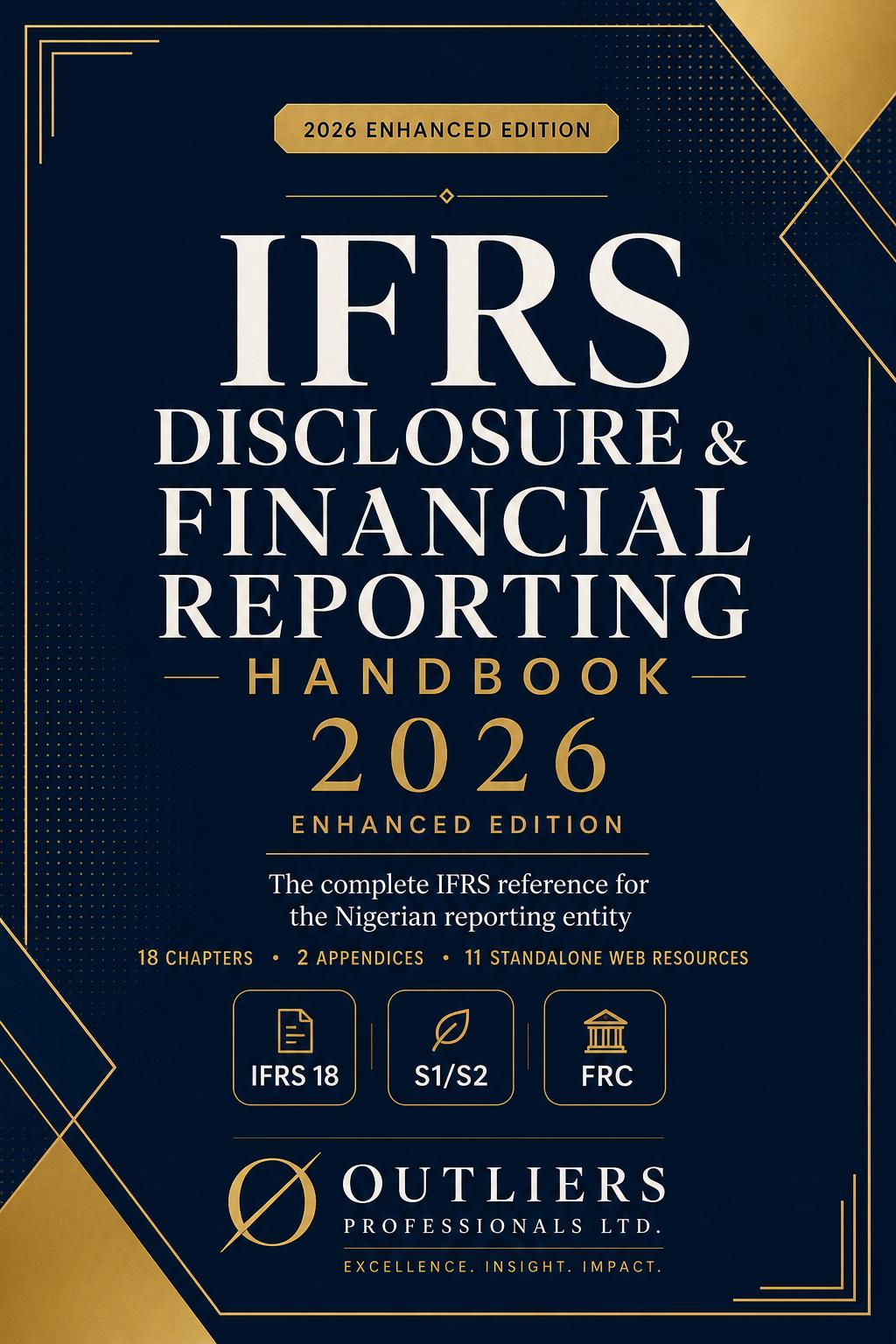
IFRS Disclosure & Financial Reporting Handbook 2026
The Handbook and the Enhancement Pack integrated into a single flagship publication, per the approved Editorial Integration Blueprint. Eighteen chapters in five parts, two appendices, and eleven standalone web resources — covering the IFRS 18 transition, the Disclosure Matrix and 180-point checklist, IFRS S1 & S2 sustainability reporting, industry-specific issues, the Outliers IFRS Framework™ (four indices), the Financial Reporting Dashboard™, the Outliers IFRS Health Check™, and the Board & Audit Committee Reporting Pack.
Eleven standalone web resources extracted from the Handbook.
Each item is published as an interactive tool or downloadable asset, linked from its parent chapter and cross-referenced from the others.
Free 10-question interactive diagnostic with RAG bands.
Open Tool · FreeScore your IFRS 18 / S1 / S2 transition readiness.
Open Tool · FreeTest disclosure completeness across 15 standards.
Open PDF · GatedOne-page grid — 15 standards · frequent omissions.
Open PDF · GatedFive CFO decisions · worked re-presentation · MPM reconciliation.
Open XLSX · GatedEditable XLSX — monthly · quarterly · year-end · FRCN.
Open XLSX · GatedRAG control panel that consumes the four Outliers indices.
Open PDF · GatedEditable meeting template — agenda, RAG subset, decisions.
Open PDF · GatedThree one-page references for the operating CFO.
Open PDF · FreeReporting Agenda at a Glance — five headline numbers.
Open PNG · FreeShareable image for board decks, LinkedIn, intranets.
Open PDF · GatedThe complete flagship publication PDF.
OpenThe Conceptual Framework for Financial Reporting.
Issued by the IASB, the Conceptual Framework underpins every IFRS Accounting Standard. It guides standard-setting, supports preparers in developing accounting policies and helps users interpret IFRS financial statements.
Objective of General Purpose Financial Reporting
Information about the reporting entity that is useful to existing and potential investors, lenders and other creditors in making decisions about providing resources.
Qualitative Characteristics
Fundamental: relevance and faithful representation. Enhancing: comparability, verifiability, timeliness and understandability.
The Reporting Entity
Boundary of the reporting entity, consolidated vs unconsolidated financial statements and combined financial statements.
Elements of Financial Statements
Definitions of assets, liabilities, equity, income and expenses — including the present-obligation and economic-resource lenses.
Recognition & Derecognition
Recognition criteria linked to relevance and faithful representation, with derecognition principles for assets and liabilities.
Measurement Bases
Historical cost and current value (fair value, value in use, fulfilment value, current cost) — selection factors and trade-offs.
Presentation & Disclosure
Communication objectives, classification, aggregation and the role of OCI in performance reporting.
Concepts of Capital & Capital Maintenance
Financial vs physical capital maintenance and the implications for profit determination.
Published practical standards.
Full write-ups with Nigerian regulatory overlay, worked examples, journal entries and cited sources — reviewer-signed and ready to apply.
IAS 1 sets the overall framework for presenting IFRS financial statements: the complete set of statements, fair presentation, going concern, materiality, offsetting, comparatives, and the split of assets and liabilities between current and non-current. It is the foundation every Nigerian preparer builds on, and it is being replaced by IFRS 18 for annual periods beginning on or after 1 January 2027, so 2026 statements still apply IAS 1 while transition planning begins.
IAS 2 requires inventories to be measured at the lower of cost and net realisable value. It defines what enters cost (purchase, conversion and other costs of bringing stock to its present location and condition), permits FIFO or weighted average but prohibits LIFO, and requires item-level NRV write-downs with capped reversals. For import-dependent Nigerian traders, manufacturers and developers, it governs landed-cost build-up, overhead absorption at normal capacity, and the FX boundary with IAS 21.
IAS 7 governs how an entity presents changes in its cash and cash equivalents over a reporting period, splitting cash movements into operating, investing and financing activities so that users can assess an entity's ability to generate cash and how that cash is used. [S1]
IAS 8 sets the hierarchy for selecting accounting policies, distinguishes a change in accounting policy from a change in accounting estimate, and prescribes retrospective correction of prior period errors, so that financial statements remain comparable and reliable over time. [S1]
IAS 10 determines when events occurring between the end of the reporting period and the date the financial statements are authorised for issue should change the numbers in the accounts (adjusting events) versus only be described in a note (non-adjusting events), and sets out the going-concern and dividend implications of such events. [S1]
IAS 12 prescribes the accounting for current and deferred tax, requiring an entity to recognise a deferred tax liability or asset for the future tax consequences of differences between the carrying amount of assets and liabilities and their tax base, alongside the current tax payable or recoverable on taxable profit for the period. [S1]
IAS 16 sets out how an entity recognises, measures and depreciates tangible items held for use in production, supply, rental or administration that are expected to be used for more than one period, and how it accounts for their subsequent revaluation and eventual derecognition. [S1]
IAS 21 prescribes how an entity determines its functional currency, translates foreign currency transactions and balances into that functional currency, and translates the results and financial position of foreign operations (and, where different, into a presentation currency), so that the effects of exchange rate changes are reported consistently. [S1]
IAS 36 requires an entity to ensure that its assets are not carried at more than their recoverable amount, setting out when to test for impairment, how to determine recoverable amount for individual assets and cash-generating units, and when a previously recognised impairment loss (other than for goodwill) may be reversed. [S1]
IAS 37 sets the recognition criteria and measurement basis for provisions (liabilities of uncertain timing or amount), and prescribes disclosure-only treatment for contingent liabilities and contingent assets, establishing that a provision is recognised only when a present obligation exists, an outflow is probable, and a reliable estimate can be made. [S1]
IAS 24 requires an entity's financial statements to disclose related party relationships, transactions and outstanding balances (including commitments) necessary to draw attention to the possibility that the entity's financial position and profit or loss may have been affected by the existence of related parties. [S1]
IAS 38 prescribes the accounting for intangible assets not dealt with specifically in another Standard, requiring recognition only when an item is identifiable, controlled by the entity, expected to generate future economic benefits, and reliably measurable, with specific rules for internally generated intangibles including a strict prohibition on recognising internally generated brands and a research/development split for internal projects. [S1]
IAS 40 governs the recognition and measurement of property (land, a building, or part of a building, or both) held to earn rentals or for capital appreciation, or both, rather than for use in production or supply of goods or services, for administrative purposes, or for sale in the ordinary course of business, and requires a choice between the cost model and the fair value model applied to all investment property. [S1]
IFRS 13 defines fair value as an exit price, sets out a single framework for measuring it (including the fair value hierarchy of Level 1, 2 and 3 inputs), and prescribes disclosures about fair value measurements, applying whenever another Standard requires or permits fair value measurement, without itself determining when fair value is used. [S1]
IFRS 15 establishes a single, principles-based five-step model for recognising revenue from contracts with customers, requiring revenue to be recognised when (or as) control of promised goods or services transfers to the customer, at an amount reflecting the consideration the entity expects to be entitled to. [S1]
IFRS 16 requires lessees to recognise a right-of-use asset and a lease liability for substantially all leases, bringing most lease commitments onto the balance sheet and eliminating the previous operating/finance lease distinction for lessees, while lessor accounting remains largely unchanged from the classification approach it replaced. [S1]
IFRS 9 governs the classification, measurement, impairment and derecognition of financial assets and liabilities, replacing an incurred-loss impairment model with a forward-looking expected credit loss (ECL) model and basing classification on an entity's business model and the contractual cash flow characteristics of each instrument. [S1]
IFRS 10 establishes a single control-based model for determining when an entity consolidates another entity, requiring consolidation whenever an investor has power over an investee, exposure or rights to variable returns from its involvement, and the ability to use that power to affect the amount of those returns. [S1]
IFRS 18 replaces IAS 1, introducing a structured statement of profit or loss with three mandatory subtotals and defined categories (operating, investing, financing), disclosure requirements for management-defined performance measures within the audited financial statements, and enhanced principles on aggregation and disaggregation, effective for annual periods beginning on or after 1 January 2027. [S1]
IFRS 3 requires an acquirer in a business combination to apply the acquisition method: identifying the acquirer, determining the acquisition date, recognising and measuring identifiable assets acquired and liabilities assumed generally at acquisition-date fair value, and recognising any goodwill or gain from a bargain purchase. [S1]
IFRS 5 specifies the accounting for non-current assets (or disposal groups) held for sale, requiring them to be measured at the lower of carrying amount and fair value less costs to sell and presented separately, and sets out the presentation requirements for discontinued operations. [S1]
IAS 27 prescribes the accounting and disclosure requirements for investments in subsidiaries, joint ventures and associates when an entity elects or is required to prepare separate financial statements, permitting each such investment to be measured at cost, in accordance with IFRS 9, or using the equity method. [S1]
IAS 28 sets out the requirements for applying the equity method of accounting to investments in associates (entities over which an investor has significant influence but not control) and joint ventures (arrangements over which parties have joint control and rights to the net assets), requiring the investment to be adjusted each period for the investor's share of the investee's profit or loss and other comprehensive income. [S1]
IAS 32 establishes principles for presenting financial instruments as financial liabilities or equity, and for offsetting financial assets and financial liabilities, working alongside IFRS 9 (recognition and measurement) and IFRS 7 (disclosure) to form the complete IFRS financial instruments framework. [S1]
IFRS 7 requires disclosures enabling users of financial statements to evaluate the significance of financial instruments for an entity's financial position and performance, and the nature and extent of risks arising from financial instruments and how the entity manages those risks. [S1]
IFRS 2 requires an entity to recognise share-based payment transactions in its financial statements, including transactions with employees or other parties settled in cash, other assets, or equity instruments of the entity, measured at fair value and expensed (or capitalised, where another Standard requires) over the period services are received. [S1]
IAS 19 prescribes the accounting and disclosure for all employee benefits except share-based payment, requiring a liability to be recognised when an employee has provided service in exchange for benefits to be paid in the future, and an expense when the entity consumes the economic benefit of that service. [S1]
IAS 23 requires borrowing costs directly attributable to the acquisition, construction or production of a qualifying asset to be capitalised as part of the cost of that asset, with all other borrowing costs recognised as an expense in the period incurred. [S1]
IAS 26 prescribes the accounting and reporting requirements for the financial statements of a retirement benefit plan itself, as a separate reporting entity distinct from the employers of the plan's participants, requiring plan investments to be reported at fair value and setting out the specific statements a defined contribution or defined benefit plan should present. [S1]
IFRS 8 requires an entity whose debt or equity securities are publicly traded to disclose information enabling users to evaluate the nature and financial effects of the business activities it engages in and the economic environments it operates in, identifying operating segments using a 'management approach' based on internal reports reviewed by the chief operating decision maker. [S1]
IAS 33 prescribes principles for determining and presenting basic and diluted earnings per share, so that performance can be compared between different entities in the same period and between different periods for the same entity. [S1]
IAS 34 prescribes the minimum content of an interim financial report and the recognition and measurement principles to be applied in preparing it, applying whenever an entity using IFRS Standards in its annual financial statements publishes an interim report asserting IFRS compliance. [S1]
IFRS 12 requires an entity to disclose information enabling users of its financial statements to evaluate the nature of, and risks associated with, its interests in subsidiaries, joint arrangements, associates and unconsolidated structured entities, and the effects of those interests on its financial position, performance and cash flows. [S1]
IFRS 11 establishes principles for financial reporting by entities that have an interest in arrangements controlled jointly, classifying every joint arrangement as either a joint operation (accounted for by recognising the party's own share of assets, liabilities, revenue and expenses) or a joint venture (accounted for using the equity method under IAS 28). [S1]
IAS 20 prescribes the accounting for, and disclosure of, government grants and other forms of government assistance, requiring grants to be recognised only when there is reasonable assurance that the entity will comply with attached conditions and that the grant will be received, and matched systematically against the costs they are intended to compensate. [S1]
IAS 29 requires the financial statements of an entity whose functional currency is that of a hyperinflationary economy to be restated into the measuring unit current at the end of the reporting period, using a general price index, so that historical-cost figures distorted by extreme inflation remain meaningful. [S1]
IAS 41 prescribes the accounting for agricultural activity, requiring biological assets to be measured at fair value less costs to sell (both on initial recognition and at each subsequent reporting date) with changes recognised in profit or loss, reflecting the view that fair value better represents the economics of biological transformation than historical cost. [S1]
IFRS 17 establishes principles for the recognition, measurement, presentation and disclosure of insurance contracts, requiring insurers to measure insurance contract liabilities at a current, risk-adjusted present value of future cash flows, replacing the wide diversity of practice permitted under the interim standard IFRS 4. [S1]
IFRS 1 sets out the procedures an entity must follow when it adopts IFRS Standards for the first time as the basis for preparing its general purpose financial statements, requiring a complete set of financial statements covering the first IFRS reporting period and the preceding comparative year, generally prepared as if IFRS had always applied, subject to specific mandatory exceptions and optional exemptions. [S1]
IFRS 6 makes limited, interim improvements to the accounting for exploration and evaluation expenditure, permitting an entity to continue applying whatever accounting policy it used immediately before adopting IFRS 6 (including expensing, or capitalising in whole or part), subject to a specific impairment test and disclosure regime, pending a more comprehensive future review of extractive activities accounting. [S1]
IFRS 19 permits an eligible subsidiary without public accountability, whose ultimate or intermediate parent produces publicly available consolidated financial statements complying with IFRS Accounting Standards, to apply the recognition, measurement and presentation requirements of full IFRS Standards while using reduced disclosure requirements specified within IFRS 19 itself. [S1]
IFRS 14 is a narrow, interim Standard permitting a first-time adopter of IFRS that was subject to rate regulation under its previous GAAP to continue recognising and measuring its regulatory deferral account balances using its previous GAAP policies, pending completion of the IASB's broader project on rate-regulated activities. [S1]
IFRS S1 sets out the overall requirements for an entity to disclose information about its sustainability-related risks and opportunities that is useful to primary users of general purpose financial reports in making decisions about providing resources to the entity, establishing the foundational disclosure framework the ISSB's topic-specific standards (such as IFRS S2) build upon. [S1]
IFRS S2 requires an entity to disclose information about its climate-related risks and opportunities that is useful to primary users of general purpose financial reports, building on and applying IFRS S1's general framework specifically to climate matters, and fully integrating the recommendations of the Task Force on Climate-related Financial Disclosures (TCFD). [S1]
All active International Accounting Standards.
Every IFRS Accounting Standard in issue.
ISSB standards, applied for Nigeria.
Issued by the International Sustainability Standards Board and being phased in by the FRC of Nigeria. We track adoption, scope and disclosure architecture for boards and reporting teams.
What changed. What it means.
From standard to working paper.
- IFRS 9 ECL methodology & validation playbookRead guide
- IFRS 15 revenue recognition — practical decision treesRead guide
- IFRS 16 lease accounting — transition & ongoing operationsRead guide
- IFRS 17 insurance contracts — GMM, PAA and VFA mechanicsRead guide
- IFRS 18 presentation — restructuring the P&L and MPMsRead guide
- First-time adoption (IFRS 1) — opening balance sheet workbookRead guide
- Functional currency & hyperinflation (IAS 21 / IAS 29) for Nigerian filersRead guide
Every standard, in five minutes.
One-page primers for executives and reporting teams — the essence of each standard without the noise.
IFRS 9 in 5 minutes
Classification, expected credit loss model and hedge-accounting essentials.
IFRS 15 in 5 minutes
The 5-step revenue model with worked Nigerian examples.
IFRS 16 in 5 minutes
Lease identification, measurement and lessee disclosures.
IFRS 17 in 5 minutes
GMM, PAA and VFA — what each model means in practice.
IFRS 18 in 5 minutes
New P&L categories, MPMs and disclosure changes from 2027.
IFRS S1 & S2 in 5 minutes
Sustainability and climate disclosures — phased FRC adoption.
Field-tested, line-by-line.
The checklists our senior reporting team use during IFRS implementation, transition and annual close.
- RequestIFRS Disclosure Checklist (180-point)Annual financial statement disclosures across all active IAS/IFRS standards.
- RequestIFRS 9 ECL Validation ChecklistModel governance, staging, macro-overlays and back-testing.
- RequestIFRS 15 Revenue Recognition ChecklistContract review, performance obligations and timing of recognition.
- RequestIFRS 16 Lease Accounting ChecklistLease register, discount rates, modifications and disclosures.
- RequestIFRS 18 Transition ChecklistRestructured P&L categories, MPM reconciliation and comparatives.
- RequestFirst-Time Adoption (IFRS 1) ChecklistOpening balance sheet, mandatory exceptions and optional exemptions.
How IFRS lands in your sector.
Answers, on the record.
Curated by our senior IFRS reporting team. For entity-specific answers, book a confidential briefing.
Which IFRS standards are mandatory in Nigeria?
All IFRS Accounting Standards issued by the IASB and adopted by the FRC of Nigeria apply to public-interest entities. IFRS for SMEs applies to qualifying small and medium-sized entities.
When does IFRS 18 take effect?
IFRS 18 is effective for annual periods beginning on or after 1 January 2027, replacing IAS 1. Early application is permitted; comparative information must be restated.
Are IFRS S1 and S2 mandatory in Nigeria?
The FRC of Nigeria has issued an adoption roadmap for IFRS S1 and S2. Application is being phased in — consult the FRC's latest pronouncements for entity-specific timelines.
What is the difference between IFRS and IFRS for SMEs?
IFRS for SMEs is a self-contained standard with simplified recognition, measurement and disclosure for entities that do not have public accountability.
How are NRS, CAC and FRC filings interlinked?
Audited IFRS financial statements support CIT returns (NRS), annual returns (CAC) and FRC annual disclosures. Misalignment across the three is a common review finding.
Checklists, models & templates.
The IFRS Memo.
Monthly. One page. Every IFRS development that matters to a Nigerian board — and what to do about it.
Need IFRS applied to your business?
Book a confidential senior consultant briefing with our reporting team.
Financial Reporting Council of Nigeria (FRCN): Reporting, Governance and Sustainability Standards
The Financial Reporting Council of Nigeria (FRCN) oversees financial reporting, corporate governance and related standards for a wide range of entities in Nigeria. Its work connects Nigerian requirements with globally recognised reporting frameworks, making it a useful anchor point for finance and governance teams.
What it covers
- IFRS for private-sector financial statements
- IPSAS for relevant public-sector bodies
- Nigerian Code of Corporate Governance (NCCG)
- Sustainability disclosure standards such as IFRS S1 and IFRS S2
- Professional registration requirements for applicable persons who prepare or sign financial statements
Common obligations
- Preparing financial statements aligned with applicable standards
- Observing corporate governance expectations
- Considering sustainability and climate-related disclosures where relevant
- FRCN registration for applicable professionals and entities
Depending on the entity's structure, sector, location and activities, obligations may apply.
Who may need support
CFOs, finance teams, audit committees, board members, company secretaries, and organisations aligning local reporting with global standards.
How Outliers Professionals can help
We support clients with financial reporting readiness, IFRS and sustainability-reporting alignment, governance documentation, review and advisory guidance. We are not a regulator and cannot guarantee acceptance, certification or a specific outcome. Businesses should confirm applicable obligations with the FRCN or a professional adviser.
Related on Outliers Professionals
Financial Reporting Council of Nigeria (FRCN): Reporting, Governance and Sustainability — A Practical Guide
The Financial Reporting Council of Nigeria (FRCN) sets and oversees standards for financial reporting, corporate governance and, increasingly, sustainability disclosure. Its remit connects Nigerian practice to globally recognised frameworks, which makes it a useful reference point for finance leaders, boards and reporting teams aligning local reporting with international expectations.
Relevant laws and official guidance
The FRCN operates under the Financial Reporting Council Act (as amended). It issues the corporate governance code: under Section 51(c) of the FRC Act, the Council is empowered to issue the Code of Corporate Governance — the Nigerian Code of Corporate Governance (NCCG) 2018. On sustainability, Nigeria is an early mover: the FRCN has adopted the ISSB's IFRS S1 (general sustainability-related disclosures) and IFRS S2 (climate-related disclosures) as the national baseline, with mandatory reporting for Public Interest Entities beginning January 2028 and SMEs following from 2030. The FRC unveiled an amended 2026 Roadmap and the Sustainability Reporting Guideline 1 (SRG 1), which introduces an “Adoption Readiness Test Assessment.” Public-sector bodies follow IPSAS-based frameworks. Confirm the current phase and timelines with the FRCN.
Who the obligations may apply to
Depending on size, sector and public-interest status, this may apply to public and larger private companies, regulated entities, and — for sustainability standards — Public Interest Entities first, with wider application over time. NCCG 2018 applies to public companies (whether or not listed), holding companies of public companies, regulated entities and others, with every other company encouraged to key into it.
Basic compliance expectations
In general terms, entities are expected to prepare financial statements aligned with applicable standards (IFRS for the private sector; IPSAS-based frameworks for the public sector), report on their application of the NCCG where it applies, and prepare for phased sustainability disclosure under IFRS S1/S2. The FRC Readiness Test is positioned as a prerequisite, with entities advised to contact the Council before beginning the adoption journey.
Common filings and submissions
These commonly include filing of financial statements, NCCG application reports using the FRCN reporting template, FRCN registration for applicable professionals and entities, and — as timelines take effect — sustainability/climate disclosures aligned with IFRS S1 and S2.
Documents or records usually required
Typically: financial statements and supporting schedules, governance policies and board records for NCCG reporting, materiality and gap analyses for sustainability readiness, ESG/ERM data and an implementation plan, and evidence of board approval of relevant policies.
Practical readiness checklist
- Confirm whether and how the NCCG 2018 applies to your entity, and prepare your application report.
- Map your reporting to the correct framework (IFRS or IPSAS-based).
- Begin a gap analysis against IFRS S1/S2 ahead of your applicable deadline.
- Build the ESG data systems and governance the readiness test looks for.
- Confirm any FRCN registration requirements for those who sign financial statements.
Common mistakes to avoid
Treating sustainability reporting as future-only and leaving data systems unbuilt; assuming the NCCG applies only to listed companies; underestimating the readiness-test and governance evidence required; and relying on outdated timelines. Confirm the current position with the FRCN.
How Outliers Professionals can support
We support clients with financial reporting readiness, IFRS and sustainability-reporting alignment, governance documentation, gap analysis, review and advisory guidance. We are not a regulator and cannot guarantee acceptance, certification or a specific outcome.
Related on Outliers Professionals
Related resources & insights.
IFRS 18 Transition: Five Decisions Before Year-End
Operating vs investing classification, MPMs, and disaggregation reset.
Read GuideFinancial Reporting & Year-End Close Readiness Guide
Free introductory readiness guide for the 2026 Nigerian reporting cycle — year-end close orientation, audit readiness, tax review and five starter templates.
Download Free Readiness GuideIFRS Disclosure & Financial Reporting Handbook 2026 (Enhanced Edition)
Flagship integrated IFRS publication — Handbook + Enhancement Pack merged into one volume per the approved Editorial Integration Blueprint. 18 chapters, 2 appendices, 11 standalone web resources.
Download FlagshipIFRS updates, monthly.
Subscribe to The Outlier Brief for IASB and FRC updates curated for Nigerian filers.
IFRS checklists, guides & articles.
IFRS Disclosure & Financial Reporting Handbook 2026 (Enhanced Edition)
Flagship integrated IFRS publication — Handbook + Enhancement Pack merged into one volume per the approved Editorial Integration Blueprint. 18 chapters, 2 appendices, 11 standalone web resources.
Download FlagshipIFRS 18 Transition: Five Decisions Before Year-End
Operating vs investing classification, MPMs, and disaggregation reset.
Read GuideFinancial Reporting & Year-End Close Readiness Guide
Free introductory readiness guide for the 2026 Nigerian reporting cycle — year-end close orientation, audit readiness, tax review and five starter templates.
Download Free Readiness GuideOutliers IFRS Disclosure Scorecard™
Self-test disclosure completeness across 15 standards — anchored to the IFRS Disclosure Matrix and the 180-point checklist.
Score Your Disclosures7-Working-Day Financial Close Checklist 2026
A day-by-day run-book for finance teams targeting an audit-ready 7-working-day monthly close.
Download Checklist (PDF)Year-End Audit Readiness Checklist 2026
26-point preparation framework — engagement set-up, FS, key estimates, controls evidence, compliance and logistics.
Download Checklist (PDF)