
Feature: cash is strategy
Why growth funded by unmanaged working capital is fragile at 26.5%, and the three levers — receivables, inventory and payables — to pull now.
Opens in a new tab · complimentary PDF · no registration required.
With the Monetary Policy Rate held at 26.5%, financing the gap between paying suppliers and collecting from customers has become expensive. This edition sets out how Nigerian businesses should manage the cash conversion cycle — receivables, inventory and payables — alongside inflation at 15.91%, the naira near ₦1,395 official, fuel and crude prices, a 13-week cash flow discipline, AI-assisted forecasting and the compliance deadlines due this month.
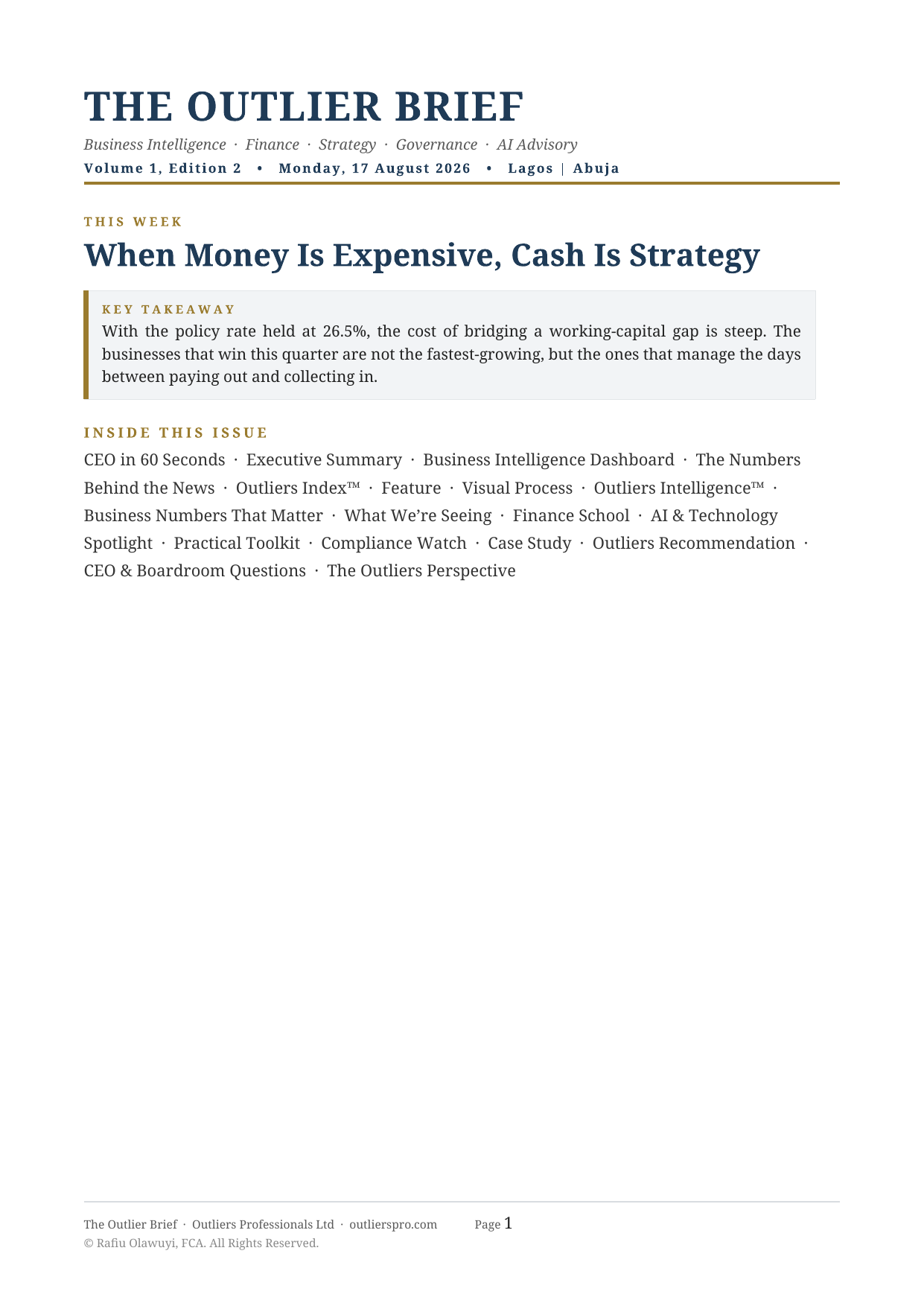
With the policy rate held at 26.5%, the cost of bridging a working-capital gap is steep. The businesses that win this quarter are not the fastest-growing, but the ones that manage the days between paying out and collecting in.
Why growth funded by unmanaged working capital is fragile at 26.5%, and the three levers — receivables, inventory and payables — to pull now.
The days between paying for inputs and collecting from customers, and why shortening that figure releases cash at no interest cost.
Inflation 15.91%, MPR held at 26.5%, naira ₦1,395 official against ₦1,425 parallel, petrol easing, Brent near $88.5 and reserves at about $52.0bn.
Composite slips to 51 as cash flow weakens to 57; tax readiness continues climbing through the NRS transition while AI adoption stays weakest.
Part two of the AI in Finance series: cash-flow forecasting tools, variance flagging and the two rules that keep AI-assisted projections safe.
A cash and working-capital checklist, July VAT and WHT returns due 21 August, covenant review, plus this week's CEO and boardroom questions.
A weekly executive briefing covering business intelligence, finance, strategy, governance, compliance, technology and the economic developments shaping Nigerian businesses.
Confirmed opt-in only. You choose to receive it, and you can unsubscribe from any edition.